English
 Korean
ISO SYSTEM
ICMC (International Certification Management Center Co., Ltd.)
-
ISO SYSTEM
-
ISO13485 In Vitro Diagnostic/ Medical Devices
- ISO13485 In Vitro Diagnostic/ Medical Devices
- ISO 22716 Cosmetics
- ISO 27001 Information Security
- ISO 27701 Privacy Information Management
- ISO 45001 Occupational Health and Safety
- ISO 15378 Primary Packaging Materials
- ISO 22000 Food Safety
- ISO 9001 Quality Management
- ISO 14001 Environmental Management
- ISO 10002 Customer Satisfaction
- ISO 22301 Business Continuity
- ISO 37001 Anti-bribery Management
- ISO13485 In Vitro Diagnostic/ Medical Devices
- ISO 22716 Cosmetics
- ISO 27001 Information Security
- ISO 27701 Privacy Information Management
- ISO 45001 Occupational Health and Safety
- ISO 15378 Primary Packaging Materials
- ISO 22000 Food Safety
- ISO 9001 Quality Management
- ISO 14001 Environmental Management
- ISO 10002 Customer Satisfaction
- ISO 22301 Business Continuity
- ISO 37001 Anti-bribery Management

icmcert@naver.com

+82-2-851-3111
ISO13485 In Vitro Diagnostic/ Medical Devices
ISO 13485 (In Vitro Diagnostic Devices / Medical Devices Quality Management System)
ISO 13485:2016 Background
IS0 13485:2003 was revised as a single standard on July 15, 2003 with the intention of unifying regulatory requirements that are applied differently in each country by stipulating the requirements for the quality management system of organizations that provide medical devices and related services. It is based on the ISO 9001:2000 standard that stipulates the requirements for the quality management system of a 'general organization', and special requirements in the medical device field have been added to the requirements. The European Union (EU) also accepted it as a European standard in July 2003, the third edition of the ISO 13485 standard was revised on March 1, 2016, and it was adopted as EN ISO 13485:2016 in Europe.
IS0 13485:2016 Quality Management System
ISO 13485:2016 is an international standard that specifies quality management system requirements for the life cycle of medical devices, such as design and development, production, storage and distribution, installation, service and final disposal. ISO 13485:2016 requirements enable the complementation of process systems within an organization to meet customer and regulatory requirements for safety and performance. It can also demonstrate to internal and external organizations, including certification bodies, an organization's ability to provide medical devices and related services that meet customer and regulatory requirements.
ISO 13485:2016 Quality Management System Model

The CEO of a medical device manufacturing/importing company satisfies customer requirements and operates the organization with ① management responsibility to ensure conformity and effectiveness of the quality management system standards. ② Provide resources for product realization, and ③ satisfy customer requirements through product realization process. After product development and sales through product realization, customers evaluate the quality of products and processes, and improve process operation by measuring and analyzing customer satisfaction and ④ process efficiency and effectiveness. By reflecting process data analysis and improvement activities in management ⑤ Continuous improvement management is performed and the effectiveness of the quality management system is maintained.
ISO 13485:2016 Necessity
- 1
- If a medical device is to be sold under its own name in the market of the European Union, ISO 13485 certificate must be submitted.
- 2
- In the case of in vitro diagnostic equipment or reagent companies, if they have ISO 13485:2016 certificate, they can issue their own performance test report and submit it as a record during GMP audit.
- 3
- Since Korean GMP is a standard based on ISO 13485, it is easy for organizations that have established the ISO 13485 system to obtain a Korean medical device manufacturing license.
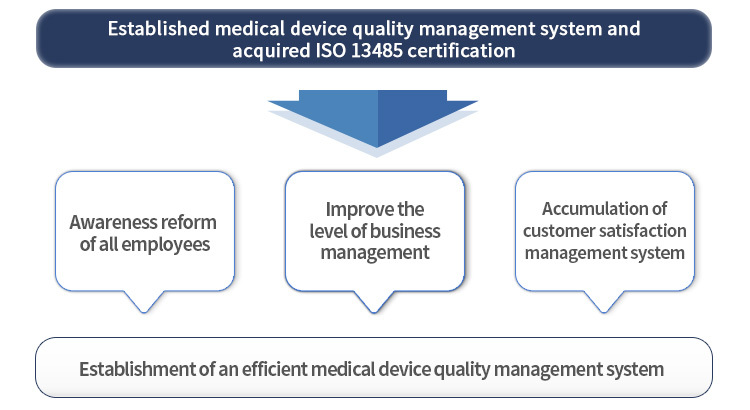
Effectiveness of introducing ISO 13485:2016
- Management of the entire product process through implementation and maintenance of the medical device quality management system
- Proactive quality management and continuous quality improvement
- Increase sales through stable response to customers' management system implementation requirements
- Improving corporate image and enhancing external competitiveness
Composition of ISO 13485:2016 Requirements
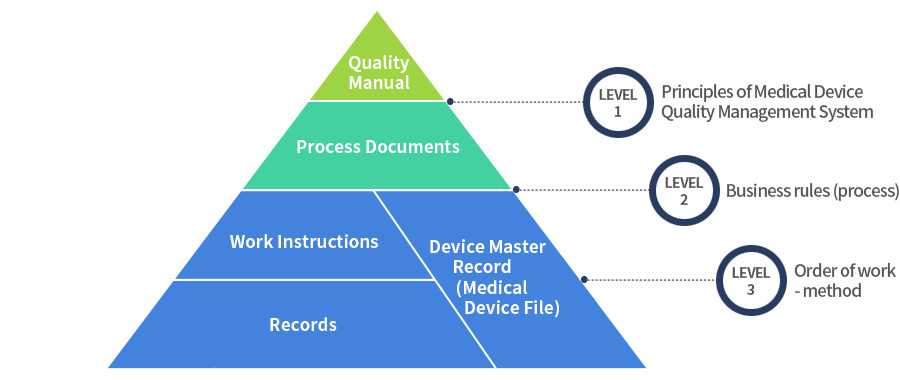
ISO 13485:2016 Documentation Structure of Medical Device Quality Management System
ISO 13485:2016 Requirements
| Title | Requirements | Title | Requirements |
|---|---|---|---|
4. Quality Management System
| 4.1 General requirements |
7. Product Realization | 7.1 Planning of product realization |
| 5. Management Responsibility | 5.1 Management commitment |
8. Measurement, Analysis and Improvement | 8.1 General requirements |
| 6. Resource Management | 6.1 Provision of resources |
ISO 13485:2016 Major Changes
Additional regulatory requirements, unique device identification(UDI) label for medical devices, medical device files, and introduction of usability increased: 60 → 72 (17 reinforced, 40 clarified, 15 unchanged)
Chapter 4. Quality Management System
- Documentation of the role the organization must play in accordance with applicable legal requirements
- Apply a risk-based approach to the management of the appropriate processes required for the quality management system
- When entrusting a process, manage it in proportion to the risks involved and include a written quality agreement in the management
- documenting procedures for validation of computer software used in the quality management system
- Medical Device File - Includes product specifications, purpose of use, storage, handling and distribution, etc.
Chapter 5. Management Responsibility
- Mandatory to include complaint handling and regulatory reporting as input to management review
Chapter 6. Resource Management
- Methods of assessing the effectiveness of education and training are proportional to the risk of the task at hand
- Contamination control for sterile medical devices: added requirements for microbial and particulate contamination
Chapter 7. Product Realization
- Determination of product-related requirements -Determining and documenting what user training is required to ensure the specified performance and safe use of a medical device
- Communication - Communicate with regulatory authorities in accordance with applicable legal requirements
- Document how to ensure traceability of design and development outputs to design and development inputs
- Include usability in input related to product requirements
- Design validation is performed on representative products (representative products are first production units, batches, or equivalent products)
- If a medical device is intended to connect to or interact with another medical device, validation should ensure that the requirements for the prescribed application or intended use are satisfied when such connection or interaction occurs
- Document the transfer procedures for manufacturing design and development outputs
- Documented procedures for validation of sterile and sterile packaging system processes
- Documenting a system that grants unique device identification to medical devices, where required by applicable statutory requirements
Chapter 8. Measurement, Analysis and Improvement
- Timely documentation of complaint procedures in accordance with legal requirements
- Documenting regulatory reporting procedures and maintaining reporting records in accordance with legal requirements
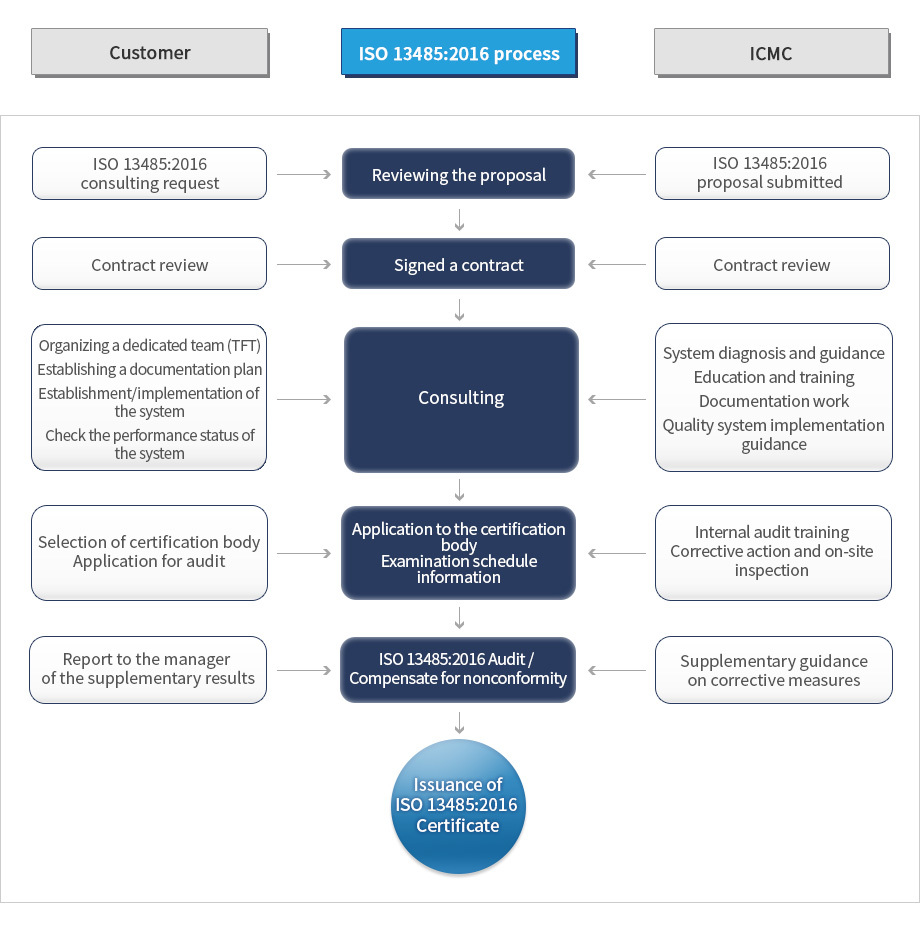
IS0 13485:2016 Certification Consulting Promotion Stage
ICMC (International Certification Management Center)
Global/Domestic RA Consulting & GMP(ISO) Internal Auditor Training
ICMC has been working tirelessly to become a customer-satisfying company by securing experienced and excellent RA consultants and audit instructors as a specialized institution for global/domestic RA consulting & GMP(ISO) internal auditor training for more than 25 years. ICMC will provide consulting services to enable the introduction of an internationally recognized system through skilled professionals. In addition, ICMC will provide training services to respond to domestic GMP and international ISO audits, strengthen practical competencies, and acquire internal audit skills. Through this, through the implementation of the global system, the safety, reliability and quality of products can be improved and international competitiveness can be secured. ICMC provides customized consulting services for global system establishment in the shortest period and minimum cost, as well as education to establish the overall concept and operation method of domestic GMP and global ISO, and will become an essential partner for entering the global market.

- Company : ICMC (International Certification Management Center Co., Ltd.)
- CEO : Bong Ju Kim
- Address: 16 Digital-ro 32-ga-gil, Guro-gu, Seoul (Guro-dong) Partner Tower 2nd Room 1001.
- TEL : +82-2-851-3111
- FAX : +82-2-2028-3115
- BIZ NO : 214-88-14891
- EMAIL : icmcert@naver.com
 10004 certified
- 27701 Certified
- Copyright(c) ICMC International Certification Management Center. All Rights Reserved.